
How to Source Dehydrated Food Products from India for International Markets
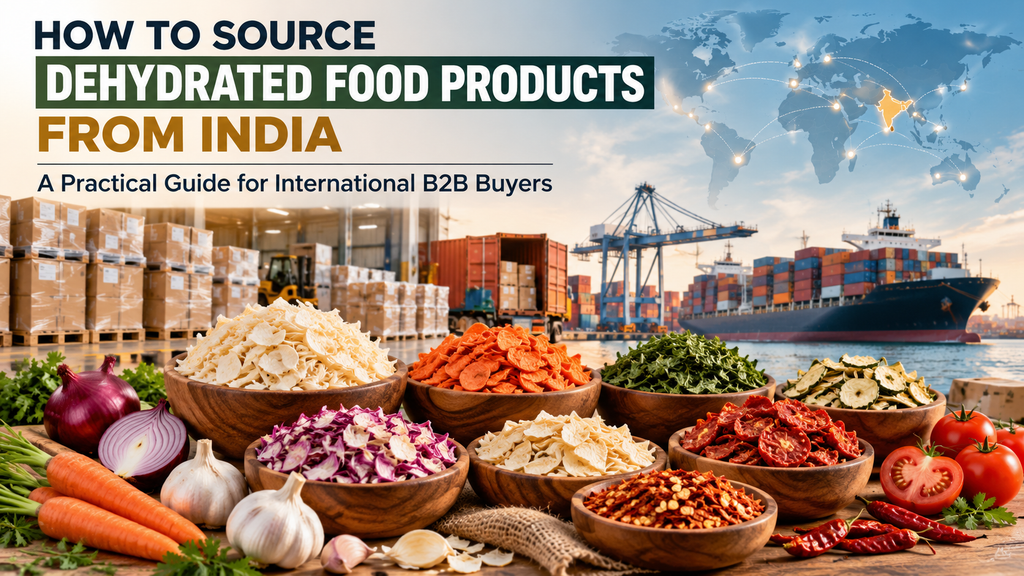
Dehydrated food products from India are increasingly relevant to international B2B buyers looking for convenient ingredients for food manufacturing, processing, distribution and commercial applications. India offers a diverse agricultural base and a broad food-processing ecosystem, creating sourcing opportunities across many food ingredient categories.
However, successful international sourcing involves much more than finding a supplier and comparing prices. Buyers need to evaluate product specifications, quality requirements, samples, packaging, documentation, commercial terms and destination-market requirements before placing an order.
This guide explains 7 reliable steps for sourcing dehydrated food products from India and what international buyers should consider before working with an Indian supplier.
Table of Contents
For WordPress, I recommend using your Table of Contents plugin to automatically generate the headings below.
What Are Dehydrated Food Products?
Dehydrated food products are food products or ingredients from which moisture has been removed through a controlled drying or dehydration process.
Depending on the product, dehydration can make ingredients easier to handle, store and transport while providing convenient formats for commercial food applications.
Dehydrated products can include different types of vegetables, fruits, herbs, spices, powders and other processed food ingredients.
The characteristics of each product depend on factors such as the raw material, processing method, dehydration conditions and required product specifications.
For international B2B buyers, the important consideration is not simply whether a product is dehydrated. The product should also match the technical, quality and commercial requirements of the intended application and destination market.
Why Source Dehydrated Food Products from India?
India has a large agricultural sector and an established food-processing ecosystem. This creates opportunities for international buyers looking for different food ingredients and processed agricultural products.
Sourcing dehydrated food products from India can provide access to:
- Diverse agricultural raw materials
- Dehydrated food ingredients
- Processed food products
- Spices and spice ingredients
- Herbal ingredients
- Botanical ingredients
- Different product forms and specifications
- Bulk B2B sourcing opportunities
For buyers, the advantage is not simply product availability. A suitable Indian supplier can also help coordinate product specifications, quantities, packaging and commercial requirements.
However, suppliers should always be evaluated individually. Product quality, specifications, capacity, documentation and export experience can vary between businesses.
7 Steps to Source Dehydrated Food Products from India
1. Define Your Product Requirement Clearly
Before contacting a dehydrated food products supplier India, clearly define what you need.
A professional B2B product requirement should ideally include:
- Product name
- Product form
- Cut or size
- Grade
- Moisture requirements
- Colour requirements
- Intended application
- Required quantity
- Packaging requirements
- Destination country
- Expected delivery schedule
- Required documentation or certifications
For example, instead of sending:
“I need dehydrated onion.”
An international buyer can provide a more detailed enquiry:
“We are looking for dehydrated onion for commercial food manufacturing. Please provide available specifications, product form, packaging options, MOQ, documentation and quotation.”
A detailed requirement allows suppliers to understand the enquiry more accurately and makes it easier for buyers to compare quotations.
2. Find the Right Dehydrated Food Supplier in India
Once your requirement is defined, identify suppliers that can potentially meet your product and commercial requirements.
International buyers may search for terms such as:
- Dehydrated food products supplier India
- Dehydrated food exporter India
- Dehydrated food ingredients supplier
- Dehydrated vegetables supplier India
- Bulk dehydrated food products India
- Indian food ingredients supplier
However, don’t select a supplier simply because their website appears professional or because they provide the lowest price.
Consider:
- Product portfolio
- Product specifications
- Business information
- Sourcing or production capabilities
- Export experience
- Packaging options
- Documentation
- Sample availability
- Communication
- Supply capacity
- Ability to meet your quantity requirements
For larger transactions, appropriate supplier and commercial due diligence should be conducted before making a significant financial commitment.
3. Request Detailed Product Specifications
Product specifications are one of the most important parts of B2B food sourcing.
Before comparing quotations, ask suppliers for relevant specifications for the exact product being offered.
Depending on the product, specifications may include:
- Product form
- Cut or size
- Moisture
- Colour
- Ingredients
- Processing method
- Shelf life
- Storage conditions
- Microbiological parameters
- Packaging
- Other product-specific quality parameters
The exact requirements depend on the product and its intended application.
For example, a food manufacturer may require more detailed specifications than a wholesaler purchasing a standard commercial product.
Don’t Compare Price Alone
Two suppliers can quote different prices because their products may have different:
- Specifications
- Quality parameters
- Packaging
- Quantities
- Commercial terms
- Delivery arrangements
Therefore, always compare like-for-like product specifications before making a purchasing decision.
4. Request Samples Before Placing a Large Order
For international B2B sourcing, samples can be an important part of supplier evaluation.
Before placing a larger commercial order, buyers can request samples and evaluate them according to their internal purchasing and quality procedures.
Depending on the product, sample evaluation can include:
- Appearance
- Colour
- Aroma
- Texture
- Product size
- Moisture
- Application performance
- Packaging condition
If the dehydrated ingredient will be used in food manufacturing, buyers can also test how the ingredient performs in the intended application.
A product that looks suitable visually may perform differently during processing. Therefore, application testing can be useful when appropriate.
5. Confirm Packaging and Shipping Requirements
After evaluating the product, discuss packaging and logistics before finalizing the commercial order.
Packaging requirements can depend on:
- Product type
- Quantity
- Destination
- Storage conditions
- Shelf-life requirements
- Transportation method
- Buyer requirements
Discuss details such as:
- Primary packaging
- Secondary packaging
- Bulk packaging
- Net weight
- Gross weight
- Carton or bag specifications
- Product labelling
- Storage instructions
- Palletization, where applicable
The buyer and supplier should also clearly agree on shipping responsibilities and applicable commercial terms.
For international transactions, the agreed commercial conditions should be properly documented.
6. Check Destination-Market Requirements
This is an important consideration when sourcing dehydrated food products from India.
Food products entering another country may be subject to requirements relating to:
- Food safety
- Product standards
- Labelling
- Ingredients
- Packaging
- Testing
- Certificates
- Import documentation
- Customs procedures
Requirements can differ significantly depending on the destination country and product category.
International buyers should therefore verify the requirements applicable to their specific product and destination market before placing an order.
Useful official resources can include:
APEDA – Agricultural and Processed Food Products Export Development Authority
https://apeda.gov.in/
DGFT – Directorate General of Foreign Trade
https://www.dgft.gov.in/
FSSAI – Food Safety and Standards Authority of India
https://www.fssai.gov.in/
For international food standards, buyers can also refer to:
Codex Alimentarius – FAO/WHO
https://www.fao.org/fao-who-codexalimentarius/
The exact documents, certifications and compliance requirements should be confirmed for the specific product and destination market.
7. Compare Suppliers Based on Quality, Service and Value
Price is an important part of procurement, but it should not be the only consideration when selecting a dehydrated food products supplier India.
A useful supplier comparison can include:
| Factor | What to Check |
|---|---|
| Product | Exact product and specification |
| Quality | Relevant quality parameters |
| Sample | Sample evaluation |
| Quantity | MOQ and supply capacity |
| Packaging | Export-suitable packaging |
| Documentation | Required product/commercial documents |
| Communication | Response time and clarity |
| Logistics | Shipping and delivery arrangements |
| Commercial Terms | Payment and agreed trade terms |
| Consistency | Ability to meet repeat requirements |
A supplier who understands your specification and communicates clearly can make international sourcing easier to manage.
Product Specifications International Buyers Should Confirm
Before finalizing a purchase, create a clear product specification sheet.
Product Details
- Product name
- Product form
- Cut or size
- Grade
- Botanical/scientific name, where applicable
Quality Details
- Moisture
- Colour
- Appearance
- Microbiological requirements
- Other product-specific parameters
Commercial Details
- MOQ
- Required quantity
- Packaging
- Price
- Payment terms
- Delivery terms
Documentation
Depending on the product, destination and transaction, buyers may require relevant commercial and product documentation.
The exact requirements should be confirmed with the supplier, buyer’s import team, logistics/customs professionals and relevant authorities.
Packaging and Shipping Considerations
Proper packaging is important when transporting dehydrated food products internationally.
The packaging should be selected based on the product’s characteristics, storage conditions, transportation requirements and destination-market expectations.
Before confirming an order, discuss:
- Primary packaging
- Secondary packaging
- Bulk packaging
- Net weight
- Gross weight
- Carton specifications
- Bag specifications
- Labelling
- Storage instructions
- Palletization where applicable
The buyer and supplier should also confirm the agreed shipping terms and responsibilities.
Quality and Compliance Considerations
Quality requirements should be established before commercial production or shipment.
International buyers should clearly communicate their quality expectations and request relevant product documentation where required.
Depending on the product and market, this may include:
- Product specifications
- Test reports
- Certificate requirements
- Food safety documentation
- Batch information
- Traceability information
- Packaging information
Buyers should also distinguish between supplier-provided information and independently verified compliance.
For larger or regulated transactions, buyers may consider appropriate third-party inspection, testing or supplier audits according to their procurement procedures.
How to Evaluate an Indian Dehydrated Food Supplier
Before finalizing a supplier, ask clear questions.
Product Questions
- What exact product specification do you offer?
- What product forms and sizes are available?
- What is the minimum order quantity?
- Can you provide samples?
Quality Questions
- What quality parameters are available?
- Can you provide relevant product documentation?
- What are the recommended storage conditions?
- What is the stated shelf life under recommended storage conditions?
Export Questions
- Do you supply to international markets?
- What export packaging options are available?
- What documents can you provide?
- What shipping arrangements can you support?
Commercial Questions
- What is your quotation?
- What are the payment terms?
- What is the expected lead time?
Having these questions ready makes supplier comparison more systematic.
Common Mistakes International Buyers Should Avoid
Choosing Only on Price
The lowest quotation may not represent the lowest overall procurement cost if product specifications, packaging, documentation or consistency differ.
Not Defining Specifications
A vague requirement can result in quotations for different products, grades or specifications.
Skipping Sample Evaluation
Samples can help buyers identify differences before committing to a larger order.
Ignoring Destination Regulations
Import requirements vary according to the country and product. Verify applicable requirements before ordering.
Not Confirming Packaging
Packaging requirements should be agreed before production and shipment.
Poor Communication
International sourcing requires clear communication about specifications, quantities, timelines, documents and commercial terms.
Why Work with an Indian B2B Ingredient Supplier?
Working with a specialized B2B ingredient supplier can simplify communication between international buyers and Indian sourcing networks.
A supplier such as MV Global Ventures can discuss requirements relating to:
- Product specifications
- Quantity
- Packaging
- Sourcing options
- Commercial requirements
- Export-related coordination
For buyers who need multiple ingredient categories, working with a supplier offering dehydrated food products, Indian spices, herbal ingredients, nutraceutical ingredients and dried botanical ingredients can also simplify supplier communication.
Source Dehydrated Food Products from India with MV Global Ventures
MV Global Ventures provides B2B sourcing solutions for businesses looking for dehydrated food products from India.
Our portfolio includes dehydrated food products along with other ingredient categories such as Indian spices, herbal ingredients, nutraceutical ingredients and dried botanical products.
We work with:
- Importers
- Distributors
- Wholesalers
- Food manufacturers
- Ingredient buyers
- International B2B buyers
If you have a specific requirement, share your product name, specifications, quantity, packaging requirements and destination with our team.
Looking for Dehydrated Food Products from India?
Send your requirement to MV Global Ventures and discuss your B2B sourcing needs with our team.
CTA: Request a Quote
Conclusion
Sourcing dehydrated food products from India can be a structured process when international buyers clearly define their requirements and evaluate suppliers based on product specifications, quality, samples, packaging, documentation, commercial terms and destination-market requirements.
Rather than comparing suppliers only on price, buyers should consider the complete sourcing requirement and determine whether a supplier can consistently meet the required product and commercial specifications.
A clear sourcing process can make communication with Indian suppliers more efficient and help international buyers manage procurement more effectively.
Frequently Asked Questions
What are dehydrated food products?
Dehydrated food products are food products or ingredients from which moisture has been removed through a controlled drying or dehydration process. They can be used in various food-processing and commercial applications.
How can I source dehydrated food products from India?
Start by defining your product specification, identify suitable Indian suppliers, request product information and samples, evaluate quality, confirm packaging and documentation, and verify the requirements of your destination market.
What should I ask a dehydrated food supplier?
Ask about product specifications, MOQ, quality parameters, samples, packaging, shelf life, documentation, lead time, payment terms and shipping arrangements.
Can I buy dehydrated food products in bulk from India?
B2B suppliers can provide bulk sourcing depending on the specific product, supplier capacity, MOQ and agreed commercial requirements.
What documents are required for importing dehydrated food products?
Documentation depends on the product, transaction and destination country. Buyers should verify the applicable requirements with relevant authorities, customs/logistics professionals and their importing team.
For More Details Contact Us
Contact No : +917385380811
Email: info@mvglobalventures.com